Ketho’s landing on Anarres
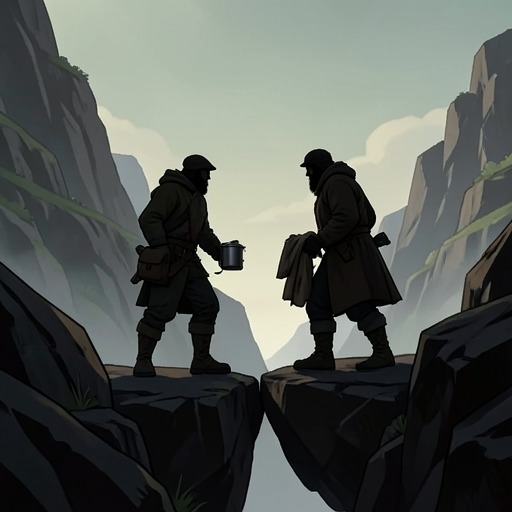
The DispossessedKetho’s landing on Anarres is the final test of Shevek’s return: will the closed settlement treat its boundary as an unquestionable rule, or can people choose to cross it together? Ketho, a Hainish officer drawn to Odo’s writings, asks to land on his own initiative. Shevek agrees to take him, but not as a foreign envoy or a guest insulated from Anarresti life. The decision makes the wall a matter of responsibility and choice, and leaves Ketho facing the same uncertain freedom Shevek has chosen to rejoin.
The inherited boundary
The Terms of the Closure of the Settlement of Anarres prohibit Urrasti from going farther than the boundary of the Port. The restriction is not merely a technical limit on where visitors may travel: as Shevek’s mother Rulag states during the argument about whether he can return, nobody is to be allowed off the freight ships beyond the port boundary. Her formulation exposes the settlement’s exclusion as an operative rule, not an abstraction. An old adviser argues that the restriction must have been intended for Urrasti rather than Anarresti, but Rulag answers that a person coming from Urras is an Urrasti. The language of the rule can therefore turn a person’s origin into the reason they are denied passage.
Ketho’s case makes that inherited distinction harder to maintain. He is Hainish, not Urrasti, and Shevek observes that the stated terms do not forbid him specifically. Ketho counters that when Anarres was settled, no other races were known, so the rule should be understood to include all foreigners. The disagreement is not resolved by pretending the prohibition has no authority: Shevek acknowledges that its terms are still accepted. Instead, he challenges the way its scope was decided and preserved.
Ketho’s choice
Ketho tells Shevek plainly that he wants to land with him. As an officer aboard a mission ship, he has a duty to explore and investigate a new world when possible; the commander would permit it, and the possibility had been discussed with ambassadors before the voyage. Yet the ambassadors chose not to make a formal request, knowing that Anarres forbids foreigners to land. Ketho’s arrival is thus neither an official diplomatic demand nor an accidental breach arranged behind the settlement’s back. Shevek asks whether the wish is Ketho’s own initiative, and Ketho confirms that it is entirely his.
His interest predates Shevek’s visit to Urras. Reading Odo’s works first made him curious about Anarres, and he has begun to learn Pravic, though he says he knows little of it. These details make the request more than professional reconnaissance: Ketho is approaching the settlement through its ideas and language, while acknowledging that he remains a newcomer. His answer to Shevek’s warning that landing may be dangerous is equally direct: he understands.
Refusing another wall
Before agreeing, Shevek considers the rule’s history. Sixty years earlier, when the Hainish first came into the solar system and tried to speak with the Anarresti, the settlement’s managers decided that the restriction on Urrasti applied to all foreigners. Shevek believes that decision was wrong: in his view, the managers were building more walls. His objection reaches beyond a narrow reading of the rule. It contests the habit of extending an existing prohibition until it becomes a barrier to people and possibilities the original terms could not have anticipated.
That challenge does not mean Shevek promises Ketho an easy or safe welcome. He explains that things on Anarres are unsettled. Radio messages from his friends have told him that events have broken loose while he was away; his Syndicate and his journey had been intended to shake things up, disturb habits, and make people ask questions. If Ketho lands with him, still more will be unsettled. Shevek says he cannot push too far, and cannot bring Ketho as an official representative of a foreign government: that status would not work on Anarres. The crossing is possible precisely as a personal act, not as an extension of state authority.
Shared responsibility at the threshold
Shevek describes what the crossing will mean in reciprocal terms. Once Ketho walks through the wall with him, Shevek will regard him as one of them: they will be responsible to Ketho, and Ketho to them. He will have the same options as the other Anarresti, but Shevek emphasizes that those options are not safe. Ketho may find himself very much alone. The welcome is therefore neither a promise of protection nor a declaration that difference disappears. It is an offer of membership whose risks and obligations accompany its freedoms.
Ketho accepts the uncertainty without claiming that Anarres is unprecedented in the long history of his people. Hain has been civilized for a thousand millennia, he says, and has tried everything, including anarchism; he himself has not tried it. He wonders why anyone is born if each individual life is not new. Shevek answers in Pravic, “We are the children of time,” and Ketho repeats the words in Iotic. Their exchange links the choice to land with the novel’s larger insistence on new beginnings: a political experiment may have a history, but encountering it remains a distinct act in a single life.
The decision moves from argument to procedure when the commander of the Davenant reports that the landing craft has received its entry pattern from Anarres ground control. The commander, a short, iron-colored Terran described as cool and businesslike, asks whether they are ready to begin the launch procedure. Shevek answers yes. Ketho comes to stand beside him at the port. The narrative ends the episode at the edge of departure, with permission and danger still in view, but the decision no longer hypothetical: Ketho is preparing to cross the boundary with Shevek.